
Region-Specific Infrastructure: Data Residency and Zero Egress Costs for CI
WarpBuild now offers region-specific infrastructure on enterprise plans. Pin your CI data to the region you choose and eliminate all ingress and egress costs from your cloud.
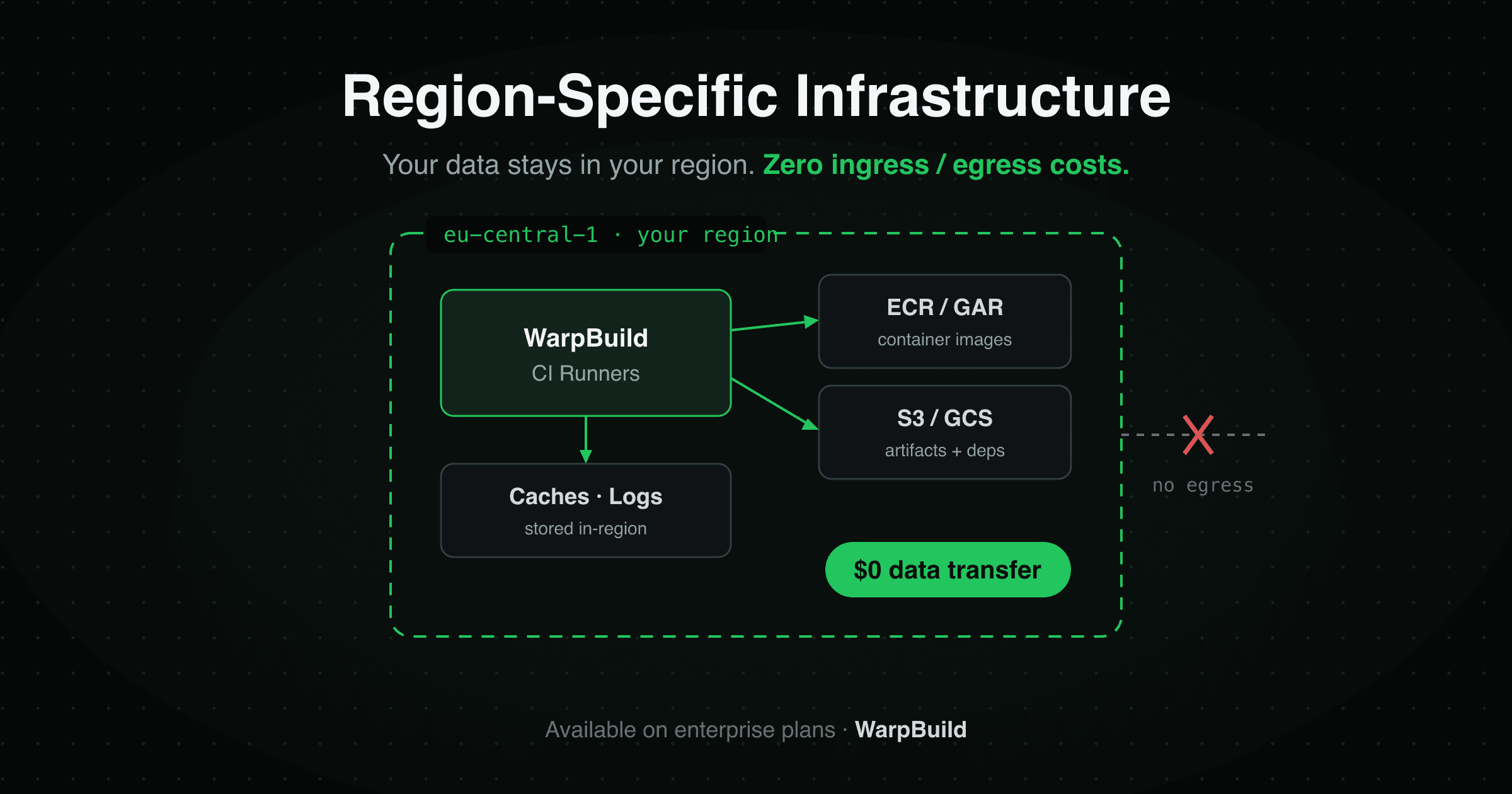
WarpBuild now offers region-specific infrastructure on enterprise plans. Choose a region, and any data you choose remains in that specific region - runners, caches, artifacts, and logs included. Because your builds now run next to your data, this also eliminates all ingress and egress costs from your cloud (not applicable to macOS instances).
This post covers why we built it, and why data transfer is the most underrated line item on a CI-heavy cloud bill.
The hidden line item in your CI bill
When teams audit CI costs, they look at runner minutes. That's the visible part. The invisible part is what your cloud provider bills you every time a build running somewhere else touches your data:
- Container registry pulls - Every job that pulls images from ECR, GAR, or a self-hosted registry pays data transfer on the way out of your cloud.
- Artifact and cache traffic - Build outputs, test fixtures, and dependencies flowing to and from S3 or GCS buckets.
- NAT gateway processing - Traffic from private subnets gets billed per-GB on top of the transfer itself.
- Internal services - Builds that hit your package mirrors, databases, or staging APIs pay transfer both ways.
None of this shows up on your CI provider's invoice. It shows up on your AWS or GCP bill, scattered across DataTransfer-Out-Bytes, NAT gateway processing, and per-service transfer lines - which is exactly why it goes unnoticed.
The math gets ugly fast
Take a representative example. AWS charges roughly $0.09/GB for data transfer out to the internet, and NAT gateway processing adds $0.045/GB on top for traffic leaving private subnets.
Now consider a mid-sized engineering team:
- 200 CI jobs per day
- Each job pulls a 4GB base image plus layers from ECR
- Each job downloads ~1GB of dependencies and artifacts from S3
That's roughly 1TB of data leaving your cloud every day - about 30TB a month. At internet egress rates, that's $2,700/month for registry and artifact egress alone, before NAT gateway processing, before cross-region replication, and before anyone runs a retry.
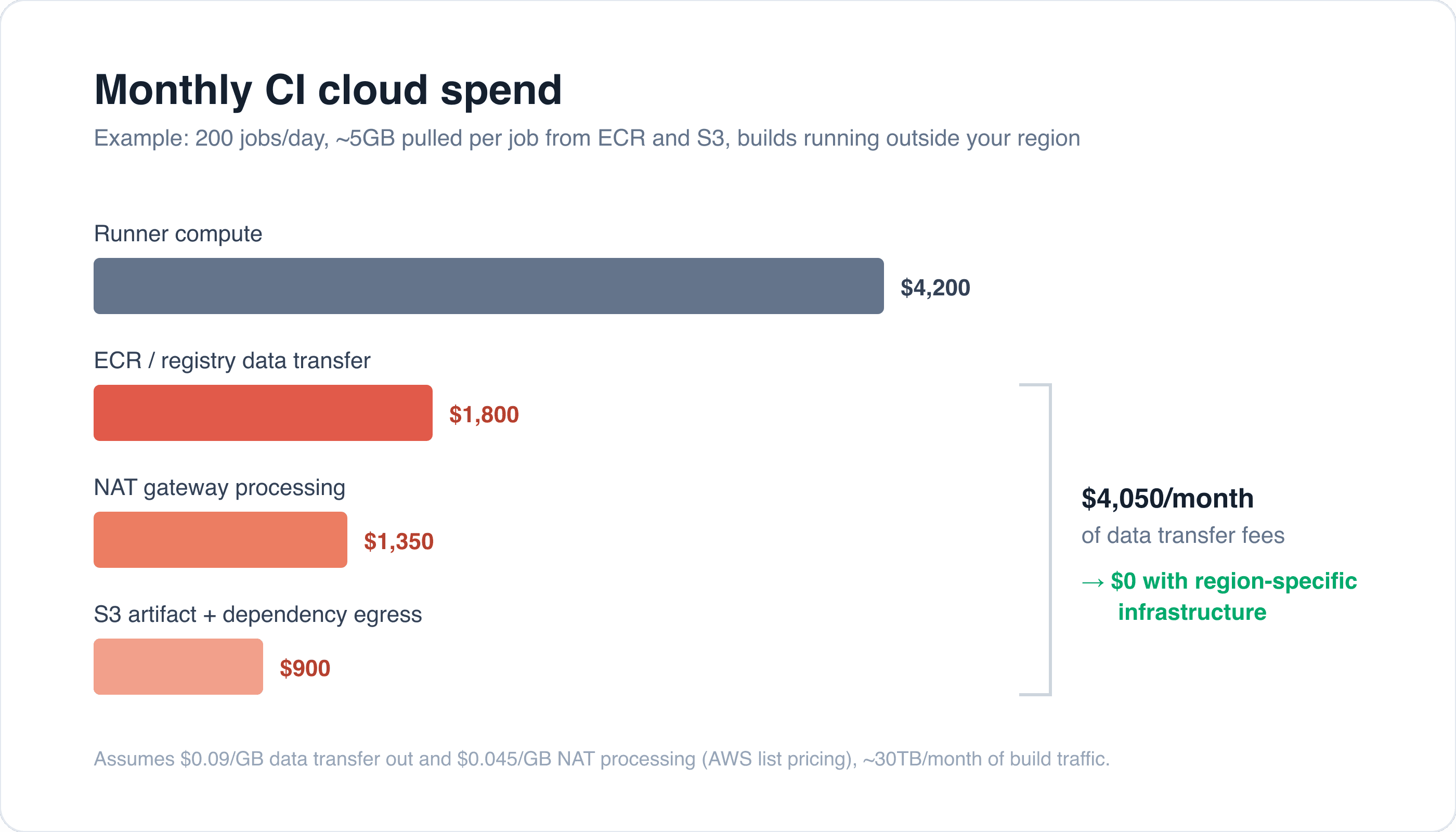
For teams doing serious container work - monorepos, ML images, multi-arch builds - data transfer regularly accounts for a significant percentage of total CI-related cloud spend. We've seen bills where ECR and S3 transfer costs rivaled the compute cost of the builds themselves. The dirty secret is that this money buys you nothing: it's the same bytes, moving the same direction, billed only because the build ran in the wrong place.
The fix: run the builds where the data lives
Data transfer pricing has one giant loophole: same-region traffic to S3, ECR, GAR, and GCS over the right paths is free. The bytes don't change. The location does.
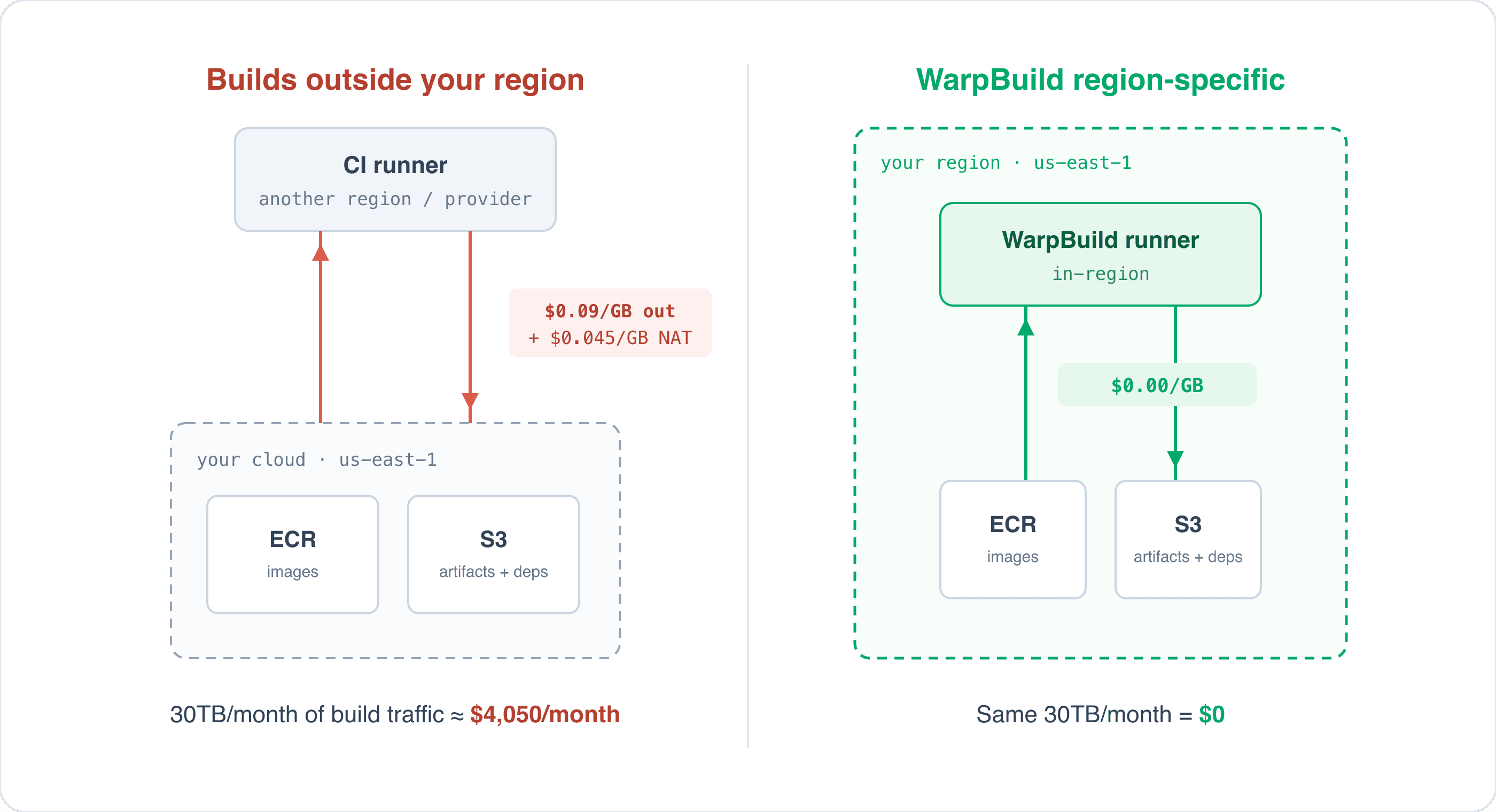
That's what region-specific infrastructure does:
- You pick the region. Any AWS or GCP region -
eu-central-1for your Frankfurt data,us-east-1next to your production stack, wherever your data already lives. - We provision runner infrastructure there. Same WarpBuild runners, warm pools, and unlimited concurrency - just physically located where you need them.
- Your chosen data never leaves. Caches, artifacts, and logs are stored and processed in-region. Nothing you pin to the region crosses its boundary.
- Your cloud's transfer meter stops. Image pulls, artifact downloads, and service calls become same-region traffic. All ingress and egress costs from your cloud are eliminated.
The zero ingress/egress benefit applies to Linux and Windows runners. It is not applicable to macOS instances, which run on dedicated Apple Silicon hardware outside your cloud provider.
Data residency, not just cost savings
The same property that kills the transfer bill also answers a compliance question that comes up in almost every enterprise conversation: where does our data go?
With region-specific infrastructure, the answer is simple - it stays where you put it. Any data you choose remains in that specific region. For teams subject to GDPR, regional data protection laws, or internal data residency policies, that turns CI from a compliance exception into a non-issue. It also pairs naturally with GitHub Enterprise Cloud's data residency offering, so your source code and your build infrastructure can live under the same regional guarantees.
Available on enterprise plans
Region-specific infrastructure is available today on WarpBuild enterprise plans, alongside Dedicated Cloud and BYOC. There are no workflow changes beyond the runner label - your team won't notice anything except faster pulls.
Last updated on